

Memory & Learning
Key researchers involved in LMC2 : S. Blanchet, V. La Corte, S. Nicolas, S. Pacton, P. Piolino, M. Sperduti
Dedicated funding : Labex ‘‘Empirical Foundations of Linguistics” (ANR-10-LABX-0083) et APPROLEX (DEGESCO), INSERM-TRANSFERT SNCF, ANR FICTION, DGA & ENAC, MNRT
Within this research area, we will conduct a series of studies to experimentally investigate the mechanisms underlying explicit and implicit learning, spontaneous episodic memory, and memory distortions (Schacter, 2012), for example by adapting laboratory paradigms to virtual environments and developing new VR paradigms.
In real-world environments, memory is intrinsically dependent on emotion, attention, perception, action, and self-relevance at the time of encoding, as well as on the social context (Hommel, 2004). From an embodied cognition perspective, the body and the mind are interconnected constructs that cannot be considered separately, as they profoundly influence one another (Wilson, 2002; Barsalou, 1999). Without adopting all of the more radical theoretical assumptions of embodied cognition (Versace and al., 2014), and using multimodal measures, this project will seek to understand how and under what conditions these factors contribute to the formation, storage, and retrieval of true and false memories, as well as of memories of different types.
We will use a machine learning approach based on multi-level measures to predict memory performance. Whenever possible, experiments will be conducted with school-aged children, adolescents, and younger and older adults. We will therefore focus on characterizing the developmental mechanisms underlying memory (PIs: N. Angeard, I. Jambaqué, S. Pacton) and the mechanisms involved in memory ageing (PIs: A. Baudouin, V. La Corte, P. Narme), as well as on identifying factors that promote memory (e.g. : attention; M. Sperduti, S. Blanchet).
More specifically, we plan to investigate implicit and explicit memory processes, from encoding to long-term retrieval, using explicit and implicit measures collected through classical laboratory experiments and virtual environments. S. Pacton investigates how children learn the spelling of new words ( LABEX EFL, Pacton and al., 2013; 2014). For example, he will adapt paradigms used to study implicit learning, such as the serial reaction time (SRT) task, to virtual reality settings, an approach that, to our knowledge, has not yet been implemented.
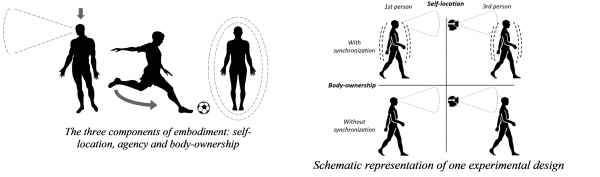
Effets de The explicit or implicit role of embodiment in memory
S. Blanchet and M. Sperduti aim to gain a better understanding of the links between attention and memory (e.g., dual-task paradigms, Posner’s Attention Network Test, online measures of mind-wandering) as a function of the types of situations experienced in VR (PhD A. Armougum, as part of a decision-making study in the virtual Saint-Michel train station, in collaboration with SNCF; PhD P. Blondé, in the context of episodic encoding). In addition, these aspects will be investigated in temporal memory and time-based memory processes (A. Baudouin), false memory and prospective memory (V. La Corte & P. Piolino), and emotional and social memory (P. Narme & N. Angeard).
We will investigate the effects of explicit versus implicit embodiment on spatial memory (S. Nicolas, in collaboration with IFSTTAR; PhD S. Lhuillier; PostDoc A. Afonso, ANR RASPUTIN) and on long-term episodic memory (P. Piolino; PhD P. Blondé, in collaboration with M. Sperduti), as well as on the sense of presence and different levels of consciousness and emotional states (ANR SUBLIMAE, in collaboration with M. Sperduti).
Another innovative research program will continue to investigate predictors of the formation of episodic autobiographical memories using immersion in virtual reality (IUF Piolino). We will examine the behavioural and neurocognitive signatures of the formation and consolidation of incidental memories, as well as predictive models using a machine learning approach (PhD K. Abichou, in collaboration with F. Vialatte). We plan to manipulate various factors that may modulate personal experiences and the context during encoding while participants are immersed in everyday-life virtual situations, and to use different retention intervals at retrieval, ranging from 1 day to 6 months.
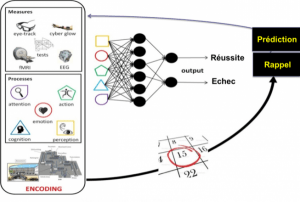
Predictors of the Formation and Consolidation of Episodic Autobiographical Memory