
Memory, Self & Temporality
Key researchers involved in LMC2 : P Piolino, V. La Corte, E. Bertrand, B. Fauvel, A. Baudouin, M. Sperduti,
PhD students and postdoctoral researchers involved : I., Colàs-Blanco, L. Compère, D. Lenormand, S. Salgues
Grants : IUF Piolino 2014-2019, ANR Temporality, ANR Sublimae

The aim of this research program is to further investigate the cognitive and neural bases of episodic and semantic autobiographical memory (AM) and episodic future thinking, as well as their interactions with personal and social identity and the multiple dimensions of temporality, using classical and virtual embodied methods.
Building on the previous project, we will investigate the neural substrate of the interaction between autobiographical memory and the sense of identity in healthy individuals and psychiatric patients. The interaction between the sense of identity and AM is complex. Indeed, AM comprises both episodic and semantic memories. The latter, generated through a process of generalization, may contribute to the construction of the core self in healthy individuals. Furthermore, episodic memory is thought to be essential for updating self-representations and self-awareness (Conway, 2005; Klein, 2010).
As part of this line of research, we have developed a new fMRI activation paradigm based on self-concept judgments (“I am” from one’s own perspective versus “I am” from the perspective of others) and associated AM memories. This paradigm is currently being administered to (i) patients experiencing transgender dysphoria (TGD) and controls, in collaboration with T. Gallarda at Sainte-Anne Hospital (PHRC TRANSMEM, PostDoc L. Compère), and (ii) participants at the prodromal stage of schizophrenia (Ultra High Risk for psychosis, UHR) compared with healthy controls and patients with schizophrenia, in collaboration with the MO Krebs team at CPN (a project initiated with PhD student C. Mam-Lam-Fook, DENIKER, ancillary study of the PHRC START, MO Krebs). These projects are conducted in collaboration with the Sainte-Anne neuroimaging platform. The main hypothesis is that the neurocognitive signature of AM and the self may serve as a marker of TGD and UHR status.
The novelty of subsequent investigations will lie in studying episodic future thinking about events in the future, including possible personal and social selves, which refer to beliefs about what the self was and what it might become (Markus & Nurius, 1986; Sani et al., 2007; D’Argembeau & Van der Linden, 2004). Indeed, the role of personal and impersonal semantic representations in future thinking, as well as the respective contributions of explicit and implicit processes, remain markedly understudied, despite the crucial role of future thinking in adaptive and social behaviour and well-being.
The main objective of the present proposal is to take this research several steps further by investigating the neurocognitive mechanisms underlying individuals’ ability to mentally travel through time, taking into account all episodic and semantic components and their links with personal and social identity. Our main hypothesis is that the semantic content of future projections, both personal and collective, increases with temporal distance and ageing, thereby affecting personal and social identity and well-being. We will explore the mechanisms of temporal projection over timescales ranging from a few seconds to several decades.
This approach will shed light on the interaction between memory, temporality, and personal and social identity. This innovative project has the potential to provide a new taxonomy of future thinking and new recommendations for improving anticipation and the positive appropriation of one’s individual and collective future among older adults.
This project will adopt a transdisciplinary approach through collaborations with neuroscientists (neuropsychology, MRI, EEG) and social psychologists (ANR TEMPORALITY, 2018–2022, PIs P. Piolino and V. La Corte, with collaborators J. Collange (LaPEA), B. Sanitioso (LPS), J. L. Tavani (Paris 8), as well as IM2A and ICM, Pitié-Salpêtrière Hospital, the Sainte-Anne Neuroimaging platform, and G. Riva, Italy).
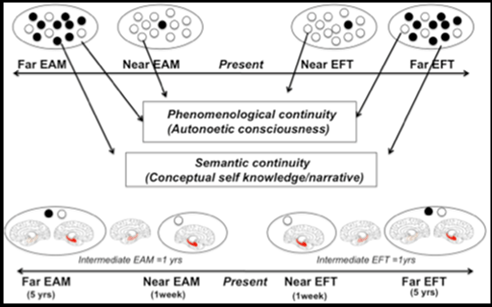
Integrative framework for the taxonomy of past and future thinking: the TEDIFT model (La Corte & Piolino, 2016)
EAM: Episodic Autobiographical Memory
EFT: Episodic Future Thinking